… I learned from making my kids’ birthday cakes.
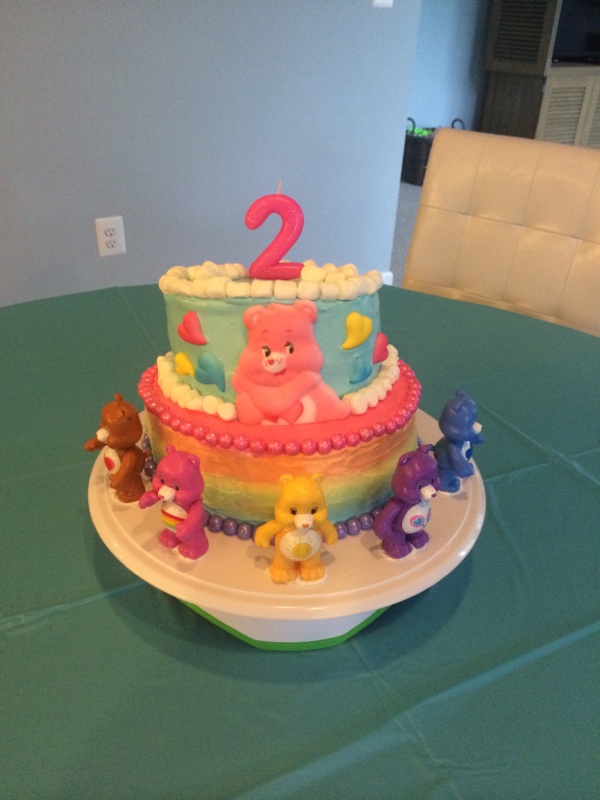
I have two little girls, one of whom just turned 2 years old last week. As I was frosting the cake for her party yesterday morning (at 5:30am, no less), I reflected that there is actually a lot to be learned from this whole cake-making business in parallel to life in general. I now have five birthday cakes under my “mom belt,” and here’s what I’ve learned so far:
Don’t try to tackle the hard parts when you’re tired. When you’re tired, everything is harder. Because you make it harder. Your mind is more susceptible to distractions at critical moments (like when it’s time to grease the pans), and your emotions are more likely to get the better of you when something goes awry. When the cake doesn’t just pop right out of the pan easily, for example, you may get angry and frustrated quickly, leading to bad decisions like hacking at it with a spatula. In fact, spatula hacking may seem like the only real option, but that’s only because you’re being thwarted by your own exhaustion. A well-rested version of you might have been able to take a step back, think creatively, change perspective, and come up with a solution less damaging to the structural integrity of the cake. Or your life. These situations can also have a snow-ball effect that finds you trying to glue things back together with frosting. Ineffectively, I might add. When this happens and you’re near tears of frustration — ready to throw the whole thing in the trash and sit down on the couch with a donut — set it down and come back to it when you’re rested.
Having the right tools on hand is a huge success factor. This statement seems very cliche, but I think the reason it’s true is not often discussed. Yes, it’s easier to do things with the right tool. But you know that it’s the right tool because you prepared yourself well, either through research or experience. You know at least some of what the challenges will be, and you’re ready for them. Mentally. Physically. Emotionally. Tools can be physical items, but they can also be techniques or processes. “I am ready,” your tools say to your task. I will cut a level cake layer, rotate the cake as I frost on my rotating cake base, and never forget to add a crumb layer of frosting to even things out. Unless I’m really tired. Then, see above.
Give it time to set. Most situations can benefit from a little review and revision. Reflection. And reflection requires distance. When you’re in the thick of things, hands covered in multiple colors of frosting and making a million constant corrections as you see any tiny imperfection, you can lose sight of the bigger picture. Your corrections may be unnecessary and, in some cases, making things worse instead of better. You need to give your work time to set. To gel. When you’ve done enough work to review, stop. Breathe. Get a cup of coffee. Wash your hands. Then come back to it. You’ll have better insight into how you can improve it. And, in the case of literal cake frosting, air actually changes the texture and makes it easier to work with, allowing you to be more fine-grained in your corrections and adjustments instead of continually mauling a big sticky glob of melting mess.
Adjust from vision to reality. At some point, you will come face to face with the fact that your vision of how it was going to be – the “perfect state” – is not the reality in which you are living. That doesn’t necessarily mean the reality is bad, but it may require you to think on your feet and adjust your plan to work with what you’ve got. Don’t get tied to that first image of perfection or you will end up ignoring the beauty of what you actually have. Get out of your head and be in the moment that’s real. Love it for what it is rather than hating it for all of the things it isn’t. That sloping side of the cake that refuses to be flat will showcase the marshmallow clouds perfectly. Marshmallowy, cloudy goodness… not a flaw.
No one is as critical of your efforts as you are. To quote Jeremy Ryan in Wedding Crashers: “I’m not perfect, but who are we kidding, neither are you. And you want to know what? I dig it.” When it comes to trying to build or create something, we tend to be our own worst critics. It’s not good enough. It’s not as good as someone else’s. I didn’t successfully create that vision that was in my head. We know that the base of the cake is full of missing chunks filled in with frosting. That a strong wind might blow the whole thing down, and even the weight of the candle on the top might prove to be too crushing. But know one else sees that. Or cares. They can appreciate it in a way that we can’t, and so we discredit the appreciation as unfounded and ignorant. But in reality, the appreciation is every bit as real as our own self-criticism. And we should be more readily accepting of it.
Accept that it will be a series of successes and failures. I don’t mean that each cake (or moment) will be either a success or failure, and that they can’t all be successes. Though that may be true as well. I actually mean that each one will be a unique combination of both success and failure. In any given moment, some things are working and some things aren’t. And we work towards and hope for a swing in the favor of more successes than failures. But acknowledging the flaws can help us balance them out. I accept that the back of this cake will be structurally challenged, crushed by its own cake weight. But the Carebear figures and chocolate bead balls really work and make the whole thing look “finished.” And I can rotate the cake on my rotating cake base to show it from its best angle. And this mango-scented candle will freshen the air to cover the burn smell still coming from my oven where the cake batter overflowed the pans when the cakes were baking and charred to an ever-smoking crisp. All in all, a win despite failures.
Stop taking it all so seriously. Relax already. It’s a freakin’ cake. For a 2 year old. Or in the larger context, it’s just life. We all just have to do our best with what we have and, at the end of the day, recognize that it isn’t perfect. And that it won’t be perfect. And that perfect is, in fact, an illusion. The kids will eat the cake, the moment will pass, and we will give it another go tomorrow.
Or in the case of cakes, on the next birthday.

 the Superwoman Manifesto